

1. WHAT IS ITR-2 & WHAT ARE THE TYPES OF INCOME TAX RETURNS?
ITR stands for Income Tax Return, it is a form used by taxpayers to report their income earned, and taxes paid by the person during a particular year is communicated to the Income Tax Department.
Types of Income Tax Return
- ITR 1(also known as SAHAJ) for individuals.
- ITR 2 for individuals having capital income.
- ITR 3 for individuals having business income.
- ITR 4 for individuals declaring income under presumptive scheme.
- ITR 5 for llp & partnership firms.
- ITR-6 for companies.
- ITR-7 for ngo, trust, societies claiming benefits of 12a & 80g.
2. WHO IS ELIGILBE TO FILE ITR 2 FOR TAX YEAR 2026-27 ?
Person having income from below mentioned sources can file ITR 2: -
- Income from Salary or Pension .
- Income from Capital Gains arising from transfer of Capital Assets including short-term and long-term.
- Income from more than Two House Property.
- Agriculture income exceeding Rs. 5000.
- Individuals who are director in the company or hold unlisted equity shares at any time during the relevant financial year.
- Hindu Undivided Family (HUFs) subject to certain condition.
- NRI may File ITR-2 if they meet the applicable eligibility conditions and do not have income chargeable under the head Profits and Gains of Business or Profession .
- Income from transfer of Virtual Digital Assets (VDA), subject to the applicable ITR-2 eligibility conditions.
- Income From other Sources such as interest income, dividend income and family pension.
- Income from foreign asset or foreign income, where applicable subject to the prescribed reporting requirements.
3. WHO CANNOT FILE ITR 2 ?
ITR 2 cannot be filed by the following persons: -
- Company (whether Public or Private).
- Partnership Firms/ LLP.
- Ngo, Trust, Societies claiming benefits of 12a & 80g.
- Individual /Huf having income from Profit and Gains from Business/ Profession.
- Individual receiving commission or remuneration, by whatever name called, due to, or received by him/ her from a partnership firm /LLP.
4. WHICH INCOME REQUIRED FILING ITR-3 INSTEAD OF ITR-2 ?
Income that cannot be shown in ITR 2 are: -
- Income shown under presumptive income scheme of Income tax Act.
- Income from Business/ Profession.
- Income taxable under the head Profits and Gains of Business or Profession including taxable interest, salary, bonus, commission or remuneration received from a partnership firm or LLP. Individuals or HUFs having such business or profession income generally need to file ITR-3, subject to the applicable rules.
5. DOCUMENTS REQUIRED TO FILING ITR-2
Following documents are required to file ITR 2: -
- Form 16 (If you have income from salary)
- Form 16A (If you have earned interest on deposits and TDS is deducted)
- Bank Interest certificates and savings account interest details.
- Form 26AS to match the corresponding TDS deducted with TDS appearing in 26AS.
- Annual Information System (AIS) and Taxpayer Information System (TIS) to match corresponding income with Form 16, From 16A.
- Bank statements and Passbook for all relevant bank accounts.
- Tenant details if you have income from House property also details of local taxes paid, interest on borrowed capital (if any) for calculation of income from House Property
- Demat account statements and capital gain reports from brokers for shares, securities and mutual fund transactions.
- Details of Virtual Digital Asset (VDA) transactions, including purchase and sale information, wherever applicable.
- Details of foreign income and foreign assets, including supporting statements, wherever applicable.
- Income from other sources like Interest Income, Dividend Income, Family Pension, Lottery Winnings and other Taxable Winnings.
- In case of capital gain transactions, you will need a summary of profit/ loss statement of capital gain transactions during the year.
- In case of capital loss, one must file ITR before due date to carry forward such loss.
- Investment details (if any).
NOTE:
Since ITR’s are annexure less forms the above-mentioned documents are not to be attached with the ITR Form. However, one needs to keep these documents as it can be demanded by the tax authorities during assessment, inquires.
6. HOW TO FILE ITR 2 ONLINE ON THE INCOME TAX PORTAL ?
By following the steps mentioned below one can file ITR-2
- Visit the income tax portal by clicking on the following link https://www.incometax.gov.in/

- Click on login and enter your pan & password to login to the income tax portal


- Click on e-file, then click on file income tax returns.

- Select the Tax Year for which you want to file ITR and select the mode of filing (here we are telling about online filing procedure).

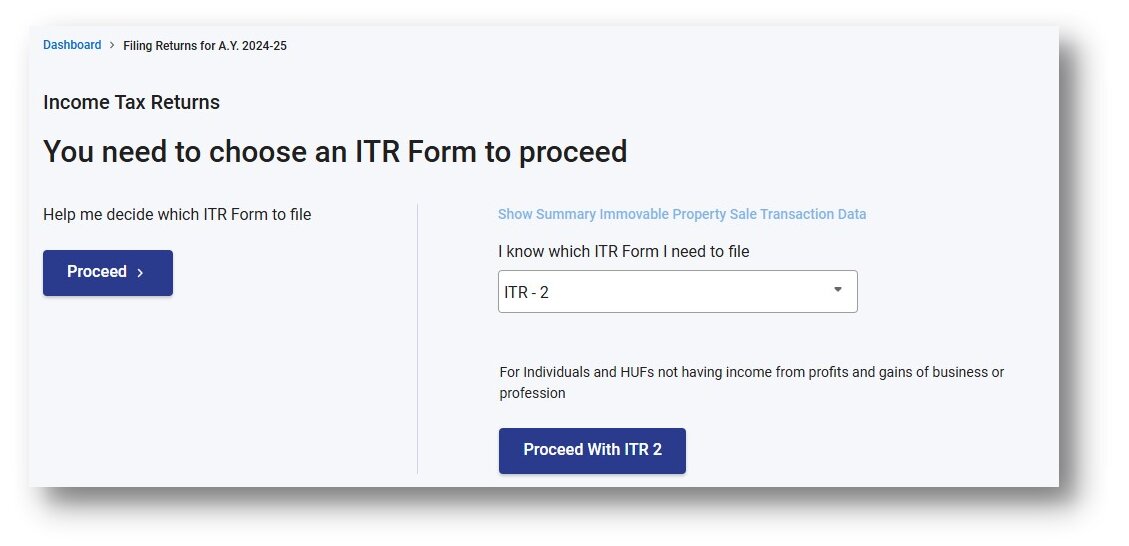
- Click on continue and select the ITR form i.e ITR-2 in our case.

- After selecting the ITR-2 for the next step is to select the schedules applicable to you for e.g. Schedule Capital Gains, Schedule House Property.

- After Selecting the schedules, the next step is to fill the basic details like directorship details, pre validated bank account etc.

- The next step is to fill the income schedules that one has selected based on the income one has: -

- In the Capital gain schedule, first select the type of Capital Asset sold: -

- After selecting the schedules fill the details accordingly into Long term or Short term Capital Gain.


- After filing the capital gain details the next step is to fill the details regarding Virtual Digital Asset sold during the year.

- After filing the VDA details the next step is to fill the details regarding income from other sources.

- The next step is to check the Schedule of current year losses and Schedule carry forward loss to correctly update your losses and also carry forward if applicable.


- The next step is to claim the deductions that you are entitled to claim under various sections like 80g, 80d, 80c etc.

- The next step is to verify the details of taxes paid by you including the TDS deducted and TCS collected from you.

- The next step is to click on total tax liability, wherein the system will automatically calculate your tax liability and if taxes paid is greater than the tax liability you will be entitled to get a refund and if the tax liability is more than the taxes paid then pay the remaining tax liability.

- After that click on preview return and verify the inputs provided by you

- Click on proceed to validation, if any error occurs clear the error and click on proceed to verification, the below error in the image will there as we need to bifurcate the capital gain into 4 quarters to calculate the interest under section 234 if any.

- If the income Tax e-filing portal displays a validation error relating to advance tax or interest under Sec 234C, review the applicable income and tax payment details and enter the required quarterly information wherever applicable. Follow the validation instructions displayed on the portal before submitting the return.

- The last step is to verify the return prepared you can verify the return through following methods: -
- Through Aadhaar OTP.
- Through digital signature (DSC)
- Through Net banking
- Through pre validated bank account
- Through pre validated demat account
- Through Net banking.
- By sending signed physical copy to the Income tax department, Bengaluru.

- After verification of the return, your return will be finally submitted to the Income Tax department for further verification.
Frequently Asked Questions (FAQ’s)
Who is eligible to file ITR-2?
Individuals and HUFs who do not income chargeable under the head Profits and Gains of Business or Profession may file ITR-2, subject to the applicable eligibility conditions.
Can an NRI file ITR-2?
Yes, NRIs can file ITR-2 if their and income and other circumstances meet the applicable eligibility conditions.
Can a director of private limited company can file ITR-2?
Yes, a director can file ITR-2 if the other applicable conditions are satisfied and the individual does not have income chargeable under the head Profits and Gains of Business or Profession
Can ITR-2 be filed online?
Yes, ITR-2 can be filed online through the official Income Tax e-filing portal or using the applicable offline utility.